
Best Business Bank Accounts in 2026: What Actually Matters
We compared 10+ business bank accounts on monthly fees, APY, FDIC coverage, and real features. See which offer $0 fees, built-in bookkeeping, and the highest interest rates.
Short on time? Here’s the quick take:
- •Best all-in-one (banking + accounting) → Holdings — $0/mo, 1.75% APY, accounting from $25/mo
- •Best for VC-backed startups → Mercury — Treasury management, up to 4% on $250K+
- •Best for physical branches → Chase — 4,700 branches, $15/mo fee
- •Best free checking with interest → Bluevine — Up to 2.0% APY with conditions
The biggest differentiator most owners miss: Holdings includes accounting from $25/mo that replaces your QuickBooks subscription. No other bank does that.
Open a Holdings Account — Free, 10 MinutesKeep reading for the full breakdown ↓
Most "best business bank accounts" articles are affiliate link farms. They list 15 banks, give each one a paragraph of marketing copy, and call it analysis. You finish reading and still don't know which account to open.
This guide is different. We'll cover what actually matters when choosing a business bank account — fees, interest, features, and the fine print — then compare the accounts worth considering in 2026. Some of these we compete with directly. We'll be honest about that.
What to Look for in a Business Bank Account
Before comparing specific banks, you need to know what you're evaluating. These are the factors that actually affect your business, ranked by how much money they'll cost or save you over time.
1. Fees (The Silent Drain)
Monthly maintenance fees range from $0 to $30. That sounds small until you multiply it: a $15/month fee is $180/year, every year, forever. But monthly fees are just the beginning.
The fees that actually add up:
- Wire transfer fees: $15–$30 per domestic wire, $35–$50 international. If you wire money regularly, this can exceed $500/year.
- ACH fees: Most modern platforms include unlimited ACH for free. Some traditional banks charge $0.25–$0.50 per transaction. At 100 transactions/month, that's $300–$600/year you didn't budget for.
- Cash deposit fees: Some banks charge after a monthly threshold — free for the first $5,000, then $0.30 per $100 after that.
- Minimum balance fees: Miss a $1,500 minimum? That's a $12 fee on top of already being short on cash.
The move: Choose an account with no monthly fees, no minimum balance requirements, and free domestic ACH. These accounts exist across multiple platforms now — there's no reason to pay for basic banking in 2026.
2. Interest Rate on Deposits
This is the single biggest differentiator most business owners overlook.
Here's the math. If your business maintains $100,000 in its checking or savings accounts — not unusual for a company with payroll, rent, and operating expenses — the difference between 0.01% APY and 1.75% APY is $1,740 per year. At $250,000, it's $4,350/year. That's real money, and most businesses leave it on the table because their bank pays essentially nothing.
Traditional banks (Chase, Bank of America, Wells Fargo) typically pay 0.01%–0.02% on business checking balances. Online platforms pay 1.0%–4.0% on savings and sometimes on checking too.
What to watch for:
- Tiered rates that only apply to the first $10,000 or $25,000
- Rates that require maintaining a high minimum balance to qualify
- Savings accounts with transaction limits (6/month under Reg D)
- Promotional rates that drop after 3–6 months
The move: Find an account that pays competitive interest on your full balance — not just a slice of it, and not just in a savings account you can't easily access.
3. Accounting and Bookkeeping Integration
This is where things have changed dramatically in the last two years.
The old model: open a bank account, buy separate accounting software (QuickBooks, Xero), manually connect them, and hope the transaction feed doesn't break. Then hire a bookkeeper to categorize everything and reconcile monthly.
The new model: some platforms now include accounting software — auto-categorization, P&L statements, balance sheets, cash flow reports — built into the banking platform. Your transactions are categorized as they happen, not weeks later. Your books largely keep themselves.
This matters because:
- Manual data entry between bank and accounting software is a waste of time and a source of errors
- Separate subscriptions add up: QuickBooks ($30–$90/mo) + bookkeeper ($300–$500/mo) is $4,000–$7,000/year on top of your banking
- When your bank and your books are the same system, reconciliation is instant — not a monthly chore
The move: If you're currently paying separately for banking, accounting software, and bookkeeping, look for platforms that bundle some or all of these. The savings compound fast.
4. FDIC Insurance Coverage
Standard FDIC coverage is $250,000 per depositor, per bank. If your business ever holds more than that — after a big client payment, during tax season, when project deposits land — the excess is uninsured.
Some platforms offer extended coverage through sweep networks that distribute your deposits across multiple partner banks. This can extend your protection to $3M–$5M+ without you managing multiple banking relationships yourself.
Who needs this: Any business that occasionally holds more than $250K in deposits. That includes more businesses than you'd think — especially around quarterly tax payments, payroll funding, or project retainers.
5. Sub-Accounts and Fund Separation
If you manage multiple projects, clients, programs, or revenue streams, sub-accounts let you track each one separately without opening entirely separate bank accounts.
Use cases:
- Law firms and agencies: Separate client retainers from operating funds
- Businesses with multiple revenue lines: Track each product or service independently
- Organizations managing grants or restricted funds: Keep program money separate with its own balance and transaction history
- Profit-first budgeting: Allocate revenue into operating, tax, profit, and owner pay accounts automatically
Not every bank offers this. Traditional banks typically require you to open (and pay for) entirely separate accounts. Modern platforms often include unlimited sub-accounts at no extra cost.
6. Team Access and Controls
If anyone besides you touches the company finances — a bookkeeper, office manager, co-founder, board treasurer — you need role-based permissions. Not everyone should be able to initiate transfers.
Look for:
- View-only access for accountants and bookkeepers
- Transaction approval workflows for payments above a threshold
- Spending limits on individual debit cards
- Real-time alerts for large transactions or low balances
The Accounts Worth Considering in 2026
We evaluated accounts based on the criteria above. We're including Holdings in this comparison because we think we stack up well — but we'll let the features speak for themselves.
For Businesses That Want Banking + Accounting in One Place
Holdings
- Monthly fee: $0
- Interest: 1.75% APY on all balances
- FDIC coverage: Extended through sweep network
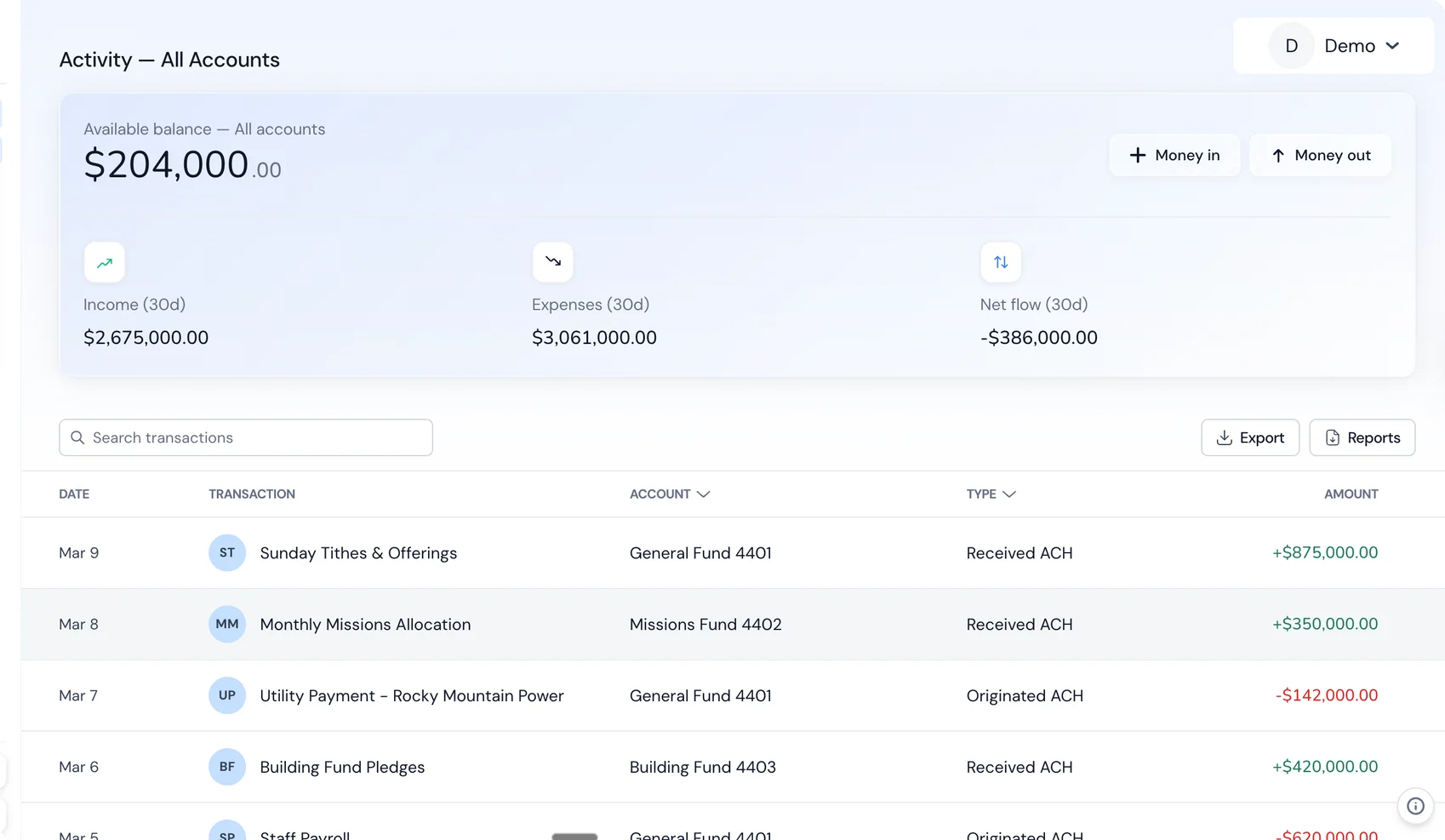
- Accounting: Built-in accounting software from $25/mo (auto-categorization, P&L, balance sheet, cash flow statements)
- Cards: Business debit cards included
- Sub-accounts: Unlimited, at no cost
- Best for: Any business that wants to stop paying separately for banking, accounting software, and bookkeeping. Service businesses, professional firms, growing companies, mission-driven organizations.
Why it's different: Most banks give you a place to hold money. Holdings gives you a place to hold money, track it, categorize it, and understand it — without bolting on three separate subscriptions. The accounting software alone replaces a $30–$90/month QuickBooks subscription for most businesses, with smart categorization doing the work an outsourced bookkeeper would charge $300–$500/month for.
For Startups and Venture-Backed Companies
Mercury
- Monthly fee: $0
- Interest: Up to 4.0% on Treasury accounts (requires $250K+ balance)
- FDIC coverage: Up to $5M through partner banks
- Accounting: None built-in. Integrates with QuickBooks, Xero, NetSuite.
- Sub-accounts: Virtual accounts for fund separation
- Best for: VC-backed startups that need treasury management, international wires, and API access for custom integrations
Brex
- Monthly fee: $0 (Essentials), $12/user/month (Premium)
- Interest: Varies by product
- FDIC coverage: Up to $6M
- Accounting: Expense management built-in, integrates with NetSuite/QBO
- Best for: Companies that want corporate cards with built-in expense management and spend controls
For Small Businesses That Want Simplicity
Bluevine
- Monthly fee: $0
- Interest: Up to 2.0% APY on checking (up to $250K with qualifying activity — requires $500/month in card spending or $2,500/month in deposits)
- FDIC coverage: Standard $250K
- Accounting: None. Integrates with QuickBooks, Xero, Wave, Expensify.
- Best for: Small businesses that want checking interest without managing a separate savings account
Relay
- Monthly fee: $0 (free plan), $30/month (Pro)
- Interest: Up to 1.0% on savings (3.0% on first $50K with Pro)
- FDIC coverage: Up to $750K
- Sub-accounts: Up to 20 checking accounts for profit-first budgeting
- Accounting: None. Integrates with QuickBooks, Xero.
- Best for: Small businesses that use profit-first or envelope budgeting across multiple accounts
Novo
- Monthly fee: $0
- Interest: 0% on checking (savings account available separately)
- FDIC coverage: Standard $250K
- Accounting: None. Strong app marketplace — connects to Shopify, Stripe, QuickBooks, Gusto.
- Best for: E-commerce sellers, freelancers, Shopify merchants who want a clean mobile-first experience
For Businesses That Need Physical Branches
Chase Business Complete Checking
- Monthly fee: $15/month (waivable with $2,000 daily balance)
- Interest: 0.01% APY
- FDIC coverage: Standard $250K
- Branches: 4,700+ nationwide
- Best for: Cash-heavy businesses that deposit daily, companies building lending relationships for SBA loans or lines of credit, multi-location operations that need consistent branch service
Bank of America Business Advantage Fundamentals
- Monthly fee: $16/month (waivable with $5,000 minimum balance)
- Interest: 0.01% APY
- FDIC coverage: Standard $250K
- Branches: 3,800+ nationwide
- Best for: Businesses already in the BofA ecosystem, companies wanting Merrill Lynch integration for business investments
U.S. Bank Silver Business Checking
- Monthly fee: $0 (with e-statements)
- Interest: 0.01% APY
- FDIC coverage: Standard $250K
- Branches: 2,200+ locations
- Best for: Businesses that want a no-fee traditional bank with branch access (strongest in the Midwest and West)
The Comparison Table
| Feature | Holdings | Mercury | Bluevine | Chase | Relay | Novo |
|---|---|---|---|---|---|---|
| Monthly fee | $0 | $0 | $0 | $15* | $0 | $0 |
| APY on checking | 1.75% | Via Treasury* | Up to 2.0%* | 0.01% | Via savings | 0% |
| Extended FDIC | ✅ | Up to $5M | ❌ | ❌ | Up to $750K | ❌ |
| Built-in accounting software | ✅ | ❌ | ❌ | ❌ | ❌ | ❌ |
| Unlimited sub-accounts | ✅ | ✅ | ❌ | ❌ | Up to 20 | ❌ |
| Physical branches | ❌ | ❌ | ❌ | 4,700+ | ❌ | ❌ |
| API access | Coming | ✅ | ❌ | Limited | ❌ | ❌ |
| Business debit cards | ✅ | ✅ | ✅ | ✅ | ✅ | ✅ |
Chase: fee waivable with $2,000 balance. Mercury Treasury: requires $250K+. Bluevine: requires qualifying activity.
How to Decide
Here's a simple framework based on what matters most to your business:
"I want the simplest setup — banking, accounting, and bookkeeping without juggling subscriptions."
→ Holdings. Free banking at 1.75% APY plus accounting software with smart categorization at $25/mo. One platform instead of three.
"I'm a funded startup and I need treasury management and API access."
→ Mercury. Best for companies with large balances that want programmatic banking and high-yield treasury.
"I just want free checking that pays interest."
→ Bluevine (up to 2.0% with qualifying activity) or Relay Pro (3.0% on first $50K).
"I deposit cash every day and need branches."
→ Chase. Nothing else comes close on branch coverage. Pay the $15/month fee or maintain the minimum — it's the cost of branch access.
"I run an e-commerce business and want integrations."
→ Novo. Best app marketplace for Shopify, Stripe, and similar platforms.
"I need to separate funds for clients, projects, or programs."
→ Holdings (unlimited sub-accounts, free) or Relay (up to 20 accounts). If you hold client funds with compliance requirements, see our guide on structuring accounts for firms that handle client funds.
What Most Comparison Articles Won't Tell You
You'll probably end up with two accounts. Most growing businesses keep a primary operating account at a modern platform (for yield, accounting, and features) and a secondary account at a traditional bank (for occasional cash deposits or a lending relationship). That's fine — just make sure your primary account is the one working hardest for you.
Interest rates change. The rates in this article reflect what's available as of March 2026. Check each platform's current rates before opening an account. Don't chase promotional rates that expire after 3–6 months — look for consistently competitive yields.
"Free" isn't always free. Some platforms make money on interchange (card swipe fees), which costs you nothing. Others make money by paying you almost nothing on deposits while lending your money at 5%+. Understand the business model so you know whose interests align with yours.
The switching cost is lower than you think. If you're stuck at a bank that charges fees and pays no interest, switching feels like a headache. It's not — most transitions take 2–4 weeks if you follow a checklist. We wrote one: Business Bank Account Switching Checklist.
Frequently Asked Questions
Can I open a business bank account online?
Yes. Most modern platforms (Holdings, Mercury, Bluevine, Novo, Relay) allow fully online account opening in under 15 minutes. You'll need your EIN, government-issued ID, and basic business information. Traditional banks may require a branch visit for at least one authorized signer.
Do I need a separate business bank account?
If you're operating as an LLC, corporation, or nonprofit, yes — both for legal liability protection and tax purposes. Even sole proprietors should separate business and personal finances. Mixing them creates accounting headaches and can jeopardize your liability protection.
How much should I keep in my business checking account?
A common rule of thumb is 2–3 months of operating expenses as a buffer. Anything beyond that should be earning competitive interest — either in a high-yield checking account or a linked savings account. If your bank pays 0.01% and you're sitting on $200K, you're leaving $3,500+/year on the table.
What's the difference between a bank and a fintech platform?
Traditional banks hold their own banking charter and are directly FDIC-insured. Fintech platforms (Mercury, Relay, Novo) partner with chartered banks to provide FDIC-insured accounts. From your perspective as a depositor, the insurance protection is the same — the partner bank holds and insures your deposits. The difference is in the software layer: fintechs typically offer better technology, lower fees, and more integrations.
Can I switch business bank accounts without disrupting payments?
Yes, if you run both accounts in parallel for 30–60 days during the transition. Redirect incoming payments first, then outgoing payments, then close the old account only after confirming no transactions are still hitting it.
See how Holdings combines free banking and built-in accounting software in one platform. Open an account — it takes about 10 minutes.
---
Related Resources
Still paying monthly bank fees?
1,000+ organizations stopped. Here’s what they got:
- ✓$0 monthly fees—actually $0, not "waivable"^
- ✓1.75% Annual Percentage Yield (APY)† on every dollar
- ✓Full accounting for $25/mo — your invoices and payments are already in your books (vs. QuickBooks)
- ✓Switch in ~30 minutes. Run both banks in parallel.
*Holdings is a financial technology company, not a bank. Banking services provided by i3 Bank, Member FDIC. ^No account or domestic transaction fees. \u2020Annual Percentage Yield (APY) is variable and subject to change. Deposits insured up to $3M through i3 Bank and program banks.