
Business Checking vs Business Savings: Which Account Do You Need?
Business checking vs savings — when you need both, when you don't, and how to pick. Plus: accounts that combine 1.75% APY with free checking. Full comparison inside.
The traditional answer is simple: checking for daily transactions, savings for reserves. But in 2026, that distinction is breaking down — some checking accounts now pay interest rates that match or beat savings accounts, and some platforms have eliminated the separation entirely.
Here's what actually matters when deciding how to structure your business accounts.
The Traditional Difference
Business checking accounts are designed for frequent transactions — paying vendors, receiving deposits, running payroll, processing card payments. Historically, they pay little or no interest but have no limits on transactions.
Business savings accounts are designed for money you don't need to access daily — emergency reserves, tax savings, future equipment purchases. They typically pay higher interest but come with transaction limits (historically 6 per month under Regulation D, though the Fed suspended this in 2020 and many banks have kept unlimited transactions since).
That was the model for decades. Here's what's changed.
Quick Comparison: Business Checking vs. Business Savings
| Feature | Traditional Checking | Traditional Savings | Modern High-Yield Checking |
|---|---|---|---|
| Transaction limits | None | 6/month (Reg D, often lifted) | None |
| Interest rate (typical) | 0.01% | 1.5–4.0% | 1.5–3.0% |
| Debit card | Yes | No | Yes |
| Check writing | Yes | Usually no | Yes |
| ACH/wire transfers | Yes | Limited | Yes |
| Monthly fees | $0–$30 | $0–$10 | Usually $0 |
| Best for | Daily operations | Idle reserves | Both |
What's Changed in 2026
Checking Accounts Now Pay Interest
For decades, the deal was simple: checking accounts offered convenience, savings accounts offered yield. That tradeoff no longer holds. A growing number of business checking accounts pay meaningful interest — and some pay more than savings accounts at traditional banks.
Here's what the landscape actually looks like:
| Platform | Checking APY | Conditions | Notes |
|---|---|---|---|
| Holdings | 1.75% | No conditions — paid on full balance | No caps, no hoops |
| Bluevine | Up to 2.0% | Requires $500/mo card spend or $2,500/mo deposits | Rate drops to 0% if conditions aren't met |
| Relay Pro | Up to 3.0% | Only on first $50K; requires $30/mo Pro plan | After $50K, drops to 0.5% |
| Mercury | 1.5% on Treasury | Manual sweep to Mercury Treasury | Not true checking yield — you move money into a separate product |
| Chase Business Complete | 0.01% | — | Yes, really. $15/month fee unless you maintain $2,000 minimum |
| Bank of America | 0.01% | — | $16/month fee waived at $5,000+ balance |
| Wells Fargo | 0.01% | — | $10/month fee waived at $500+ balance |
The spread is enormous. On a $75,000 balance, the difference between Chase (0.01%) and Holdings (1.75%) is $1,305 per year. That's not a rounding error — it's a month of software subscriptions or a decent laptop.
Some Platforms Eliminate the Distinction
Instead of separate checking and savings accounts, some platforms offer a single account type with unlimited transactions and competitive interest. You use sub-accounts to earmark funds for different purposes (taxes, reserves, operating expenses) without the friction of transferring money between accounts.
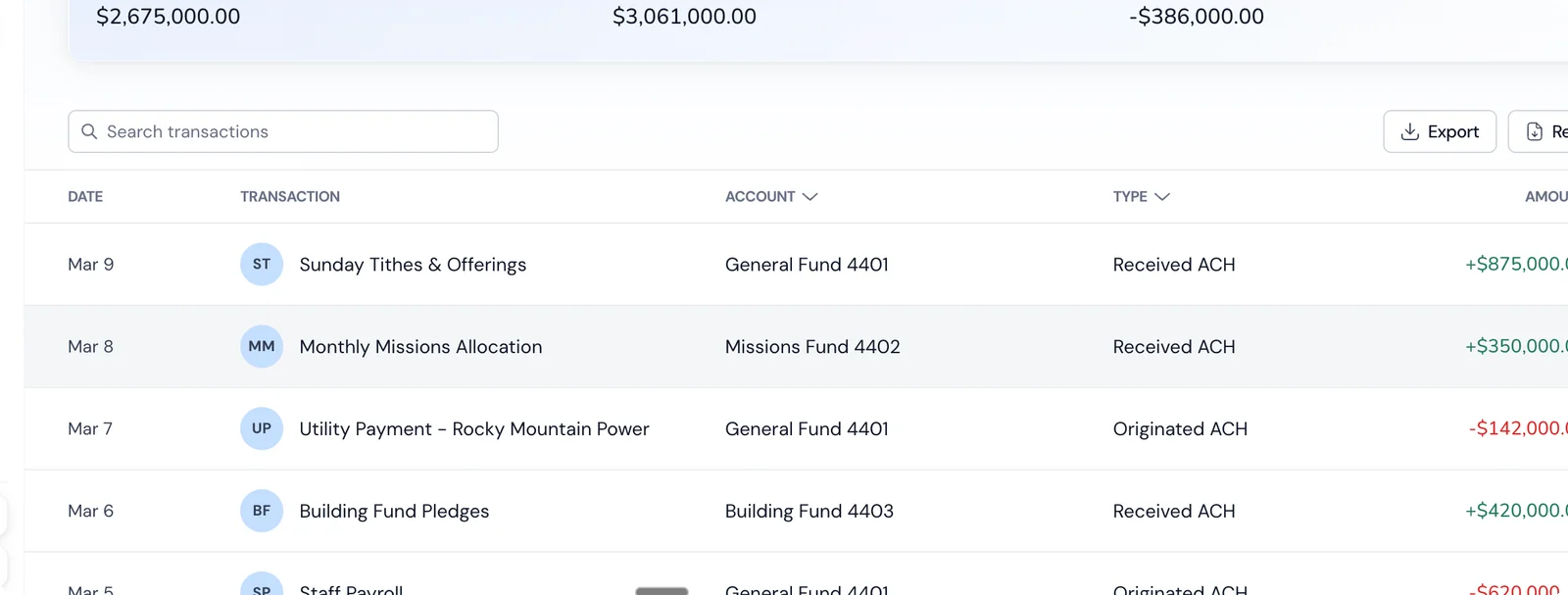
This is the approach Holdings takes — one account, unlimited sub-accounts, 1.75% on everything. Your "Operating" sub-account and your "Tax Reserve" sub-account earn the same rate with no transaction limits. The money is organized but not siloed.
Savings Transaction Limits Are Mostly Gone
Regulation D used to limit savings accounts to 6 withdrawals per month. The Fed suspended this rule in April 2020 during the pandemic, and the suspension has been maintained since. Most online banks and fintechs have permanently removed the limit.
But here's the catch: some banks still enforce it. Wells Fargo and certain credit unions never updated their policies. Before opening a business savings account, ask explicitly: "Is there a monthly transaction limit?" A savings account you can't freely access when you need to pay an unexpected vendor bill isn't much use.
Even where limits are gone, savings accounts still lack some checking features — no debit cards, no check writing, and limited ACH origination at some banks. If you need to pay a vendor from your savings account in a hurry, you may need to transfer to checking first, which adds a 1–2 day delay.
When You Need Both
Despite the convergence, there are still good reasons to maintain separate checking and savings accounts:
Your checking account pays 0.01% APY. If you're at a traditional bank that pays nothing on checking, a high-yield savings account is the only way to earn interest on reserves. The gap between 0.01% and 3.5%+ on $100K is $3,490/year. That's too much money to leave on the table.
You want a psychological barrier. Some business owners find it easier to not spend reserve money when it's in a separate account that requires a transfer to access. If your emergency fund is sitting in the same account you pay invoices from, it's tempting to dip into it when cash flow gets tight. A separate savings account forces a deliberate decision.
You need to segregate funds for compliance. Some government grants, contracts, or regulatory requirements specify that certain funds must be held in a separate account. Nonprofits receiving restricted grants, for example, often need to demonstrate that grant funds are held separately from operating funds. A sub-account might satisfy this requirement, but some grantors explicitly require a separate bank account.
Your business has seasonal cash flow. If you're a landscaping company or event planner, you might earn 70% of your annual revenue in 5 months. A savings account for off-season reserves — funded during the busy months — keeps you from scrambling in the slow period. Keeping $80K in a high-yield savings account during the winter while running a lean $15K checking balance can earn $1,400+ in interest during the off-season alone.
Your business holds very large balances. FDIC insurance covers $250,000 per depositor, per bank. If you're consistently above $250K in total deposits, spreading money across checking and savings at different institutions increases your total coverage. A business with $500K in deposits might keep $200K in checking at Bank A, $200K in savings at Bank B, and $100K in a second savings at Bank C — fully insured across the board.
You need to physically separate restricted client funds. Attorneys, property managers, and certain contractors are legally required to hold client funds in separate trust or escrow accounts, distinct from their operating accounts. This isn't a checking-vs-savings question exactly, but the principle is the same: different money for different purposes needs different containers.
When One Account Is Enough
Your checking account pays competitive interest. If you're earning 1.5%+ on your checking balance, a savings account paying 3.5% only gains you an extra $2,000/year per $100K. That's real money, but it might not justify the added complexity of managing two accounts, two logins, and transfer timing.
You use sub-accounts for fund separation. Instead of "checking" and "savings," you create sub-accounts like "Operating," "Tax Reserve," "Q2 Estimated Taxes," and "Equipment Fund." The money is organized and earmarked, but lives in one place with one login, one set of statements, and one accounting integration.
Your business is simple. Sole proprietors and freelancers with one revenue stream and straightforward expenses often overcomplicate their banking. One account with good interest and built-in accounting covers everything. You don't need to optimize every basis point when your total balance is $15K.
You want faster access to all your money. Transfers between checking and savings — even at the same bank — can take a business day. If you need every dollar accessible at a moment's notice (say, you're a contractor who occasionally needs to front materials costs), keeping everything in one checking account with sub-accounts gives you instant access without the transfer delay.
The Math: Is a Separate Savings Account Worth It?
Let's run the numbers at three different balance levels.
Business with $50,000 in total deposits
| Setup | Checking Balance | Checking Yield | Savings Balance | Savings Yield | Annual Interest |
|---|---|---|---|---|---|
| Traditional bank only | $50,000 | 0.01% | — | — | $5 |
| Traditional + HY savings | $20,000 | 0.01% | $30,000 | 4.0% | $1,202 |
| Modern checking (1.75%) | $50,000 | 1.75% | — | — | $875 |
| Modern checking + HY savings | $20,000 | 1.75% | $30,000 | 4.0% | $1,550 |
At $50K, switching from a traditional bank to modern checking alone puts $870 in your pocket. Adding a separate high-yield savings account adds another $675. Whether that's worth the extra account depends on how much you value simplicity.
Business with $150,000 in total deposits
| Setup | Checking Balance | Checking Yield | Savings Balance | Savings Yield | Annual Interest |
|---|---|---|---|---|---|
| Traditional bank only | $150,000 | 0.01% | — | — | $15 |
| Traditional + HY savings | $50,000 | 0.01% | $100,000 | 4.0% | $4,005 |
| Modern checking (1.75%) | $150,000 | 1.75% | — | — | $2,625 |
| Modern checking + HY savings | $50,000 | 1.75% | $100,000 | 4.0% | $4,875 |
Now the numbers get meaningful. The difference between modern-checking-only and modern-checking-plus-savings is $2,250/year. That's a strong argument for the two-account setup once you're consistently holding six figures.
Business with $500,000 in total deposits
| Setup | Checking Balance | Checking Yield | Savings Balance | Savings Yield | Annual Interest |
|---|---|---|---|---|---|
| Traditional bank only | $500,000 | 0.01% | — | — | $50 |
| Modern checking (1.75%) | $500,000 | 1.75% | — | — | $8,750 |
| Modern checking + HY savings | $100,000 | 1.75% | $400,000 | 4.0% | $17,750 |
At $500K, the two-account optimization earns an extra $9,000/year over single-account modern checking. But you should also be thinking about FDIC limits — you'd want to split across multiple institutions for full coverage.
How to Set Up Your Accounts
The Simple Setup (One Account)
Best for: freelancers, sole proprietors, businesses under $100K in deposits
- Open one business checking account that pays competitive interest
- Create sub-accounts for: Operating, Tax Reserve, Emergency Fund
- Set up automatic transfers: move a percentage of each deposit into Tax Reserve
- Connect accounting software (or use built-in accounting)
- Done
This takes about 30 minutes to set up. You'll spend 10 minutes per month maintaining it.
The Optimized Setup (Checking + Savings)
Best for: businesses with $100K+ in deposits who want to maximize yield
- Open a business checking account for daily operations (prioritize features: debit card, accounting integration, sub-accounts)
- Open a high-yield business savings account for reserves (prioritize yield: 3.5%+ APY, no transaction limits)
- Keep 2–3 months of operating expenses in checking — if you spend $30K/month, keep $60–$90K in checking
- Sweep excess into savings monthly — set a calendar reminder for the 1st of each month
- Set calendar reminders for quarterly tax transfers — pull from savings to checking, then pay the IRS
- Review the split every quarter — if your operating expenses change, adjust the checking buffer
The High-Balance Setup (Multiple Institutions)
Best for: businesses with $250K+ in total deposits
- Primary checking at your main banking platform (for daily operations)
- High-yield savings #1 at a separate institution (first $250K, fully FDIC insured)
- High-yield savings #2 at a third institution (next $250K, fully FDIC insured)
- Consider a Treasury management account or sweep network for balances above $750K
This is more complex, but for businesses holding large cash reserves — seasonal businesses building up for a slow quarter, nonprofits holding grant funds, or companies saving for a large purchase — the combination of FDIC protection and yield optimization is worth the extra accounts.
Frequently Asked Questions
Can my business savings account be at a different bank than my checking?
Yes, and sometimes it should be. If your checking bank pays poor savings rates, open a high-yield savings account at an online bank. Transfers between banks via ACH typically take 1–2 business days. Set up the connection once, and moving money back and forth becomes a 30-second task.
Should I keep my tax reserves in checking or savings?
If your checking pays competitive interest, keeping tax reserves in a sub-account within checking is simpler — the money is right there when quarterly payments are due, no transfer needed. If your checking pays near zero, a savings account earns more and adds a small barrier against accidentally spending tax money. The convenience factor matters: if transferring from savings to checking takes 2 days, start the transfer a few days before your estimated tax deadline.
How much should I keep in my business checking account?
The standard rule: 2–3 months of operating expenses as a buffer. This covers payroll, rent, and recurring expenses even if revenue dips temporarily. Anything beyond that buffer should be earning the highest interest rate you can get. If your monthly operating costs are $25,000, keep $50,000–$75,000 in checking and sweep the rest to savings.
Do I need a business savings account if my checking pays 1.75%?
Not necessarily. At 1.75%, your money is already working reasonably hard. A high-yield savings account might pay 3–4%, but the extra yield only matters if your balance is large enough to justify the added complexity. On $50K in reserves, the difference between 1.75% and 4.0% is $1,125/year. On $200K, it's $4,500. You decide where your complexity threshold is.
What happened to the 6-transaction limit on savings accounts?
Regulation D, a Federal Reserve rule, historically limited savings accounts to 6 "convenient" withdrawals per month (transfers, ACH, debit — but not in-person or ATM withdrawals). The Fed suspended this limit in April 2020 and has not reinstated it. Most online banks and fintechs have permanently dropped the limit. However, some traditional banks (especially credit unions) still enforce it by policy even though it's no longer required. Always ask before opening a savings account — you don't want to discover the limit when you need to make your 7th transfer in a month.
Should I use a money market account instead of savings?
Money market accounts are a hybrid — they typically offer savings-like interest rates with some checking features (check writing, debit cards). For most small businesses, the distinction between a money market and a high-yield savings account is minimal. Compare the APY, fees, and transaction features. Pick whichever pays more and has fewer restrictions.
---
Holdings business checking pays 1.75% APY on all balances with free built-in accounting software — no separate savings account needed for most businesses. [See how it works →](/banking)